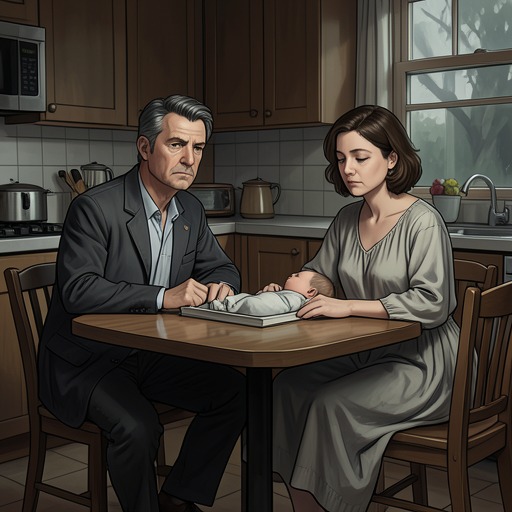
Auden overhears Robert and Heidi’s argument
Along for the RideAuden overhears Robert and Heidi’s argument when a late-night paper delivery brings her to her father’s house at almost three in the morning. Robert’s admission that he was not ready for the changes in his life turns a private marital dispute into a renewed crisis for Auden: she hears it through the history of her parents’ divorce and recognizes how much she still fears that family conflict will end in separation.
The delivery and the overheard argument
The scene begins on the road with Eli driving and Auden throwing papers. As they enter Robert’s neighborhood, she recognizes the surroundings and takes a paper from the stack, deciding that this one is hers to deliver. Her first throw misses the porch and lands on the windshield of Heidi’s Prius. Eli calls for a do-over, and Auden retrieves the paper, approaches the house quietly, and tries to place it in the center of the doormat. The small mishap matters to the scene’s structure: she has to leave the car and come close to the house before she hears what is happening inside.
At the porch, Auden hears Robert insist that he wanted Heidi to have what she wanted, then ask what he himself wants. Heidi’s shaky voice turns the argument toward the baby, asking whether he does not want the child. Robert says the dispute is not about the baby; when Heidi asks what it is about, he answers that it concerns their lives and how they have changed. He points out that he had already experienced having infants in the house, but says he was a child during those earlier experiences and is older now. His explanation ends with the blunt admission that the present situation was not what he expected and that he was not ready for it.
Heidi answers by insisting that this is his family, whether or not he feels prepared. The disagreement therefore concerns more than a single practical difficulty: Robert describes a gap between the life he expected and the life he now has, while Heidi frames the family as an existing responsibility that cannot be set aside until he feels ready. The exchange does not establish that Robert rejects the baby; he explicitly says that the argument is not about the baby. What it reveals is his distress over the changes in his life and Heidi’s insistence that the family remains theirs.
Auden leaves the porch
Auden checks her watch and sees that it is almost three A.M., a time when she assumes most people would be asleep unless something bad were happening. Hearing the argument confirms that something is wrong, but she cannot tell how broadly to understand Robert’s words about how their lives have changed. Her attention widens from the particular exchange to the possibility that it includes everything, or everyone, in the family.
The scene draws on Auden’s memory of childhood games in the cul-de-sac. She recalls knowing the rules of hide-and-seek without having really joined the games: when the person who was It came close, a player had to stay still and hope not to be found; once found, there was no way to evade the result. In the present, Auden recognizes that she is no longer a child required to remain and listen. She can leave the porch, and she chooses to disappear into the night rather than hear what her father says next. The movement away is both literal and personal: she steps out of the position of a child trapped within her parents’ conflict, even though she cannot simply escape what the argument brings back to her.
The argument’s return to Auden’s own history
Back in Eli’s truck, Auden believes she is fine as she crosses the dew-damp grass and gets in. She picks up another paper to throw, but Eli asks whether she is okay, and she begins crying. She is embarrassed to break down in front of him. He does not press her for an explanation; he continues driving and delivering papers while she looks out the window and tries to stop. By the time they reach his dark driveway, she has calmed enough to search for a way to disguise what happened, but Eli goes inside without requiring her to explain herself. She follows him up the narrow stairs beside the garage.
In Eli’s plain apartment, Auden initially accepts the opportunity to move on while he makes food. Then she names the second failure she believes she has experienced: besides struggling socially, she feels that she failed to keep her parents together. Saying it aloud helps her recognize that the fear has not disappeared. She recalls the awkward dinners, the small arguments, and the unsettled feeling in the house as evening approached. Her former response was to stretch the night around herself, staying awake and alert in an effort to keep frightening things away. That vigilance did not prevent her parents’ separation then, and hearing Robert and Heidi now makes the old fear return.
Auden explains that things have been bumpy since the baby arrived and that the argument seemed to blow up that night. Eli offers a counterexample from his own family: his parents argued sometimes, and, as he remembers it, things were better afterward. Auden does not take that reassurance as proof that her father’s marriage will be safe. She knows Robert from an earlier family history and fears that people may not change. Her memory of the argument has therefore moved from an overheard exchange to an intimate confession: she lets Eli see both the present distress and the older wound it has reopened.
Narrative significance
The scene’s emotional turn comes not when Robert raises his voice, but when Auden hears the argument at the threshold of a house she knows. The misplaced paper, the late hour, and the effort to be quiet keep the encounter grounded in an ordinary task; suddenly, the delivery route places her beside a conflict that she had thought she no longer carried. The contrast between the paper’s requested do-over and the apparent impossibility of undoing her parents’ earlier separation sharpens her sense of what can and cannot be repaired.
The night also gives Auden a choice that her childhood self did not believe she had. She leaves rather than staying to monitor her parents, but leaving does not make the encounter harmless: she cries in the truck and later names her belief that keeping her parents together was her responsibility. Eli’s quiet presence makes room for that admission without resolving the uncertainty. His belief that people change meets Auden’s fear that they do not, leaving the event’s central question open while showing that she can now speak about the past instead of only keeping watch against it.